This is my second post in a series on the importance of reading (post nr 1) and what that means for any ‘service’ or ‘read it later’ app that comes after Pocket.
I did not wake up one day as an infrequent reader and work slowly towards one hundred pages a day out of some inchoate desire for self-improvement. Rather, like many of us, I decided some years ago that if I did not take it upon myself to spend less time scrolling through Wikipedia or the AllMusic Guide or returning to my Twitter “feed”—the implicit image of a trough is appropriate—I would find myself losing one of my greatest pleasures to sheer indolence. – Matthew Walther, The Hundred Pages Strategy, The Lamp Magazine (December 2024)
Demonstrably detrimental
In a 2022 podcast interview, New York Times journalist Ezra Klein had brain researcher Maryanne Wolf as a guest. Klein had her on because one of his favorite themes for the show is the millennial lament on what we have lost with the smartphone’s rise to dominance (love these episodes, the one on the Sabbath is also really good).
Wolf’s research showed that reading from screens is demonstrably detrimental to our ability to construct complex thoughts. Brains will rewire themselves for shallow processing. When we read on screens – especially phones – we develop what Wolf calls a “skimming mindset.” We scan for keywords, jump between fragments, and lose the ability to follow complex arguments from start to finish.
If computers are bicycles for the mind, phones are actually more like those little clown tricycles. Deep reading, by contrast, activates our full neural circuitry. You’re reading off of paper. It’s slow, deliberate, and demands sustained attention. It’s a physical experience.
Wolf discovered this the hard way when she couldn’t get through a beloved Hermann Hesse book after years of digital reading. She tried to re-read Hesse’s Magister Ludi, which had been her favorite when she was an English major. But after years of digital reading, she found it “sluggish” and couldn’t get through even the first part. She had to deliberately slow herself down and read just a few minutes a day for about two weeks before she could “find her home again” in deep, immersive reading. And it took some time to retrain her brain for the kind of immersive thinking that lets us, in the words of Klein, “go beyond the wisdom of the author to discover our own.”
Zoning out
Serious reader, take note. To your brain, reading on your phone is completely different from reading on paper (possibly eInk, they didn’t get into that). The difference isn’t just comprehension, or zoning out, or the difference between reading for work and for fun. This is diminishing cognitive capacity. Skimming on your phone costs the brain a skill. The skill of being able to read for enjoyment.
If you love reading, and you want to really retain what you read, and have those EMPATHY GAINS 💪 you can’t read on your phone. And so, if in the Pocketdammerung, you’re building a read-it-later app, if you really want it to improve your reading practice, it needs to meet you where you read best. Which is: not on your phone.
(…) enormous numbers of Americans say they wish they read more than they do, if only they could figure out how. It is to such persons that the following is addressed. – Matthew Walther, The Hundred Pages Strategy, The Lamp Magazine (December 2024)
(If you’re not interested in my love of reading, go print out ‘The Hundred Pages Strategy’ instead. It’s a much better loveletter.)
Pocket’s imminent closure really awoke something in me. I didn’t know that old flame from 2022 still burned so hot 😉 I haven’t used Pocket in ages. And there are other apps that promise to help you read more, like Matter, and OmnivoreElevenReader?…, but none of them have ever really changed my behavior.
I still save web articles for later reading though, and I actually struggle a little less to find time to read these days. (I’ll share my secret in an upcoming post.) And obviously, in this age of vibe coding, a friend and I are thinking of developing our own read-it-later app, if only for private use.
So why does Pocket’s shutdown mean so much to me? It’s not about the indie apps of the early web, of which Pocket was one. And it’s not because ‘reading matters’. At least, not in the way a lot of today’s discourse talks about reading. Emphasizing the productivity gains of reading – increased empathy, brain health, cognitive and analytical skills – are, honestly, in my mind, kind of gross.
I worry. I worry about how I’m so much less able to just sit down and actually read for enjoyment. Not like I used to. Our culture produces some of the greatest reading material civilization has ever produced, at a huge scale. We can’t even read it all. And to me, Pocket’s failure as a product was that it didn’t help me read even the few things I signaled intent on. Pocket helped us save so many articles, yet it never bothered to help us actually enjoy any of it.
I despise myself for not reading more because deep down, I think of reading, and especially reading ‘the good stuff’, sort of as a civic duty, a moral obligation. Something I owe to myself and others. Maybe you feel the same way. It’s an important ritual, one that we’ve been neglecting, and everybody is worse off for it. So when I’m disappointed in Pocket, maybe I’m actually more disappointed in myself.
So when my friend and I build our own read-it-later app, it has to be better at one thing. It has to help us read more. Help us sit down and enjoy great writing (like Matthew Walther’s The Hundred Pages Strategy, seriously).
If I were to build a read-it-later product, it would aim at that specifically.
When Mozilla announced that Pocket would shut down on July 8, 2025, I felt a pang—not just because of my personal attachment to the app, but because of the broader implications about our digital habits. It got me thinking again about two articles I wrote back in 2022, when I still believed Pocket had a bright future ahead. Now, looking back, it’s clear those musings were more prescient than I realized.
The Squirrel Problem: Why Reading Apps Need to Help Us Actually Read
In my first article, I likened Pocket users to squirrels obsessively hoarding nuts. We diligently saved articles, preparing for that elusive quiet moment of reading that rarely arrived. The dopamine rush of effortlessly adding yet another story to our collection was all too real. I joked about it, but looking at use cases from the Pocket community confirmed I wasn’t alone. One user even mentioned having 1,664 articles saved—a clear testament to how saving articles had become its own compulsive activity, disconnected from actual reading.
Pocket’s Missed Opportunity
Yet behind my jokes was a serious critique. Pocket never fully embraced its unique opportunity: helping us actually make time to read. As I argued in my second article, Pocket needed to evolve beyond being a mere “digital attic”. It needed to become a space where users genuinely wanted to linger and read. Instead, Mozilla seemed keen on chasing algorithms and recommendations, the very forces often responsible for our scattered attention spans.
When Robots Reject Human Ideas
Ironically, my detailed, lovingly crafted 12-month plan for improving Pocket was swiftly rejected by Mozilla’s automated hiring system. That robotic response felt emblematic of exactly what Pocket risked becoming—yet another casualty of impersonal tech-driven decisions. I believed Pocket had the potential to stand apart as an intentional reading sanctuary, a digital haven away from endless content scrolling and mindless saving.
Now, three years later, Pocket is indeed shutting down. Mozilla cites evolving online habits and shifting priorities as reasons for the closure. They’ve pledged to carry forward Pocket’s content curation legacy through their Firefox ecosystem, such as their newsletter “Ten Tabs.” Yet, I can’t help but see this transition as a missed opportunity. Pocket’s core idea—intentional, mindful reading—seems more important than ever.
Reflecting on Pocket’s closure, I see valuable lessons for technology creators everywhere. It’s not enough to capture attention; we need to nurture and respect it. Products should help us live better, more mindful lives, not merely amplify the distractions. Pocket’s departure underscores this need profoundly.
A Bittersweet Farewell to a Digital Reading Pioneer
Ultimately, my feelings about Pocket are bittersweet. I can’t really say I’m grateful for its years of service, because I haven’t used it in years. The reading experience was just too bad. But I’m saddened by what could have been, for the promise Pocket represented, an old dream for the internet at large kept alive by this read-it-later service. And I’m hopeful that we’ll eventually figure it out.
I’m trying to be a better reader. Part of that is taking notes. So now I have all these notes about ‘Deep Work’, a book by Cal Newport about why not being distracted is so important if you want to get anything meaningful done. I thought I might as well share them.
If you like what you’re reading, remember to buy Newport’s book. It’s much more eloquent and entertaining!
Why focus and time are so important
Newport’s proposition is that for a knowledge worker to thrive in today’s world, 2 abilities matter most:
To quickly master new things: learn new skills, understand complex content, etc.
To produce at an elite level: make quality stuff.
How do you quickly master new things? Through deliberate practice: instead of ‘putting in the 10k hours’, elite learning depends on training very specific behaviour relentlessly.
For any skill you’re trying to acquire:
Focus on a specific part and train that.
Receive feedback regularly, so you can adjust your focus to where it has the most impact.
So we covered ‘learning new skills’, let’s move on to ‘producing at an elite level’.
How do you produce at an elite level? You focus on the thing that’s important. Why is focus so important? When you learn a new skill, you’re teaching your brain to fire specific neurons. Imagine your brain is a little garden. The new skill is a little garden path you want to put in. Focussing only on the new task means only the relevant neurons are engaged: you put in a nice and tidy path. Distraction means lots of neurons are fired at the same time, and nothing gets cemented: you have bricks all over your little garden.
Quickly mastering new things and producing at an elite level require: undistracted lenghts of time to put in only the relevant work. Deep work.
——
Exceptions to the rule
Newport is not an extremist (just kidding, he is), and he argues there are exceptions to this rule. For example, CEOs are not required or expected to sit in rooms for long, uninterrupted bouts of time. Devoting them to deep work is a waste of time, money and opportunities. They need to make decisions quickly.
——
Is society optimised for lots of deep work?
Newport argues: No. ‘Traditional’ open office setups, email, Twitter and Instagram and TikTok, and instant messaging all in their own way diminish peoples’ ability to do deep work, sucking away your ability for DEEP WORK.
Also, humans resist deep work naturally, because it’s hard. In an ambiguous setting, like an office, where you don’t get immediate feedback on what value each activity contributes to the bottomline, it’s easy to choose for the path of least resistance: email (busy work), chat (instant gratification), a meeting (status quo). You might recognise this train of thought: ‘I can’t choose between sending email vs. concentrating on a task based on value added, because value is hard to quantify, so I’ll optimise for time, which is easily quantifiable: guess I’ll send another quick email.’
This thought process feeds into expectations around being always available/online.
Where this type of ‘always available’ behaviour is impossible or prohibited, you automatically need to improve your planning, writing, and organisational skills.
If society doesn’t organise to value and promote deep work, Newport argues, that simply puts people who can produce deep work consistently at an advantage.
——
Deep Work and a meaningful Life
There’s more to it than just the productivity angle, though. Newport argues DEEP WORK also leads to a more meaningful life. He presents 3 arguments.
Neurological argument
In ‘Rapt’, Winifred Gallagher investigates the relation between focus and happiness. She finds people are, feel, think, act on what they focus on (there’s that word again).
Feeling drained after doomscrolling? Yeah, me too. Full of purpose and commitment after volunteering? Energised after going for a run? Etc.
Gallagher advises: for the best life, choose your targets carefully, then give them your complete attention.
Psychological argument
Flow: you feel best when stretched voluntarily to achieve something difficult but not impossible. (See also Mihaly Csikszentmihalyi’s classic: ‘Flow’.)
If you reconstruct your job so that it allows you to experience flow more often, as often as possible, you’ll feel better while doing valuable deep work.
Philosophical argument for Depth
God is dead, the philosopher will tell you. In the modern world, we tend to think there’s no magic or meaning, and we need to invent it (Nietzsche). Whereas a craftsperson does actually find meaning ‘out there’, in the material and how it confronts them with possibilities (and limitations) for whatever they’re trying to achieve with the material. Newport gives the example of the wheelwright: they have to select wood that’s right for the job, working with it to produce the best result. For the craftsman, the outside world is imbued with meaning.
Newport also argues this points to something else: don’t follow your passions, as if that will solve any problems with obnoxious colleagues, working hours, etc. Put in the hours to hone your craft, and immediately your life will gain more meaning.
——
Rules for Deep Work
Distractions are distracting because they are easy. You have to actively create an environment where you’re not distracted, where it’s easy to focus. Develop rules, routines and rituals, to take the willpower out of your quest for time and space to do deep work, otherwise you won’t make it.
Tips for how to do more Deep Work
Focus on the really important things, and cut out everything else as much as possible (be hard about it)
Act on the leading indicators, the behavioural changes, instead of the results (actively create an environment and time for focus vs. sitting and waiting for focus to happen)
Keep a compelling scoreboard (Have I done DEEP WORK RECENTLY?)
Create a cadence of accountability: reflect on achievements, what behaviour led to success?, what blocked us from achieving success?
Schedule in downtime, and keep to it. In the words of Newport: we don’t know why that works, but here are 3 possible reasons:
For things that follow rational rules, the conscious brain is better. But “the unconscious mind is better at sifting large swaths of information”. You need downtime for that part of you mind to do it’s work.
Your attention is a finite resource, and you need to replenish it (fe., with a walk in nature).
“Even experts only have 4 hours a day of concentration available for deep work.” Why guarantee that you’re going to deliver low-value work by forcing yourself to work evenings as well as days?
Implement a shutdown ritual: capture thoughts and ‘next steps’ to help you plan for the next day, and wrap up the ritual with a phrase.
Expect DEEP WORK to be a commitment. It’s not a one-time decision, it requires practice.
Take breaks from focus, not from distraction. Newport advises you to plan internet access.
Become comfortable with boredom.
Give yourself intense deadlines, so you can’t afford to be distracted. (what he calls the Roosevelt dash).
Actively think on a problem while walking/surfing/running.
Learn how to memorise a deck of cards, as the ‘Memory Palace’ memorisation technique trains the same attention span skills as DEEP WORK. –> If you’re interested in this technique check out ‘Moonwalking with Einstein’, highly recommended!
How to minimize dumb work
Everybody hates shallow work. However, you should realise:
It will never go away. Email will always be part of your life.
Deep work is exhausting. Shallow work is only dangerous if it crowds out your DEEP WORK. But you probably can manage shallow work better than you currently do:
Schedule every minute of your day, so you have to consciously have to renegotiate when something new pops up
Cap your working hours, so you can only focus on the stuff that truly matters.
Become hard to reach by email (Newport gives tips, but you can read those yourself)
Last week I shared my 12-month plan for improving Pocket. In it, I made the presumption that Pocket users want more out of the service than just saving articles. Here’s what I wrote:
Like squirrels scouring the forest to find nuts that they then methodically store and only sometimes consume, so too do Pocket users browse the web, conscientiously save articles, and then sometimes come to Pocket to read those articles. In short: it is my conjecture that people save more articles than they read.
However, I will also bet good money that most Pocket users want more time to read. If they could spend more time on Pocket and just read, like in the old days before the Internet mushed their brains, they would. It’s just that they feel drawn to their darn phones so much.
I was just basing that on my own experience. I save articles like I’m planning a long stay at a cabin in the woods (with good wifi). And then the next time I have a free moment – all those 72 times a day -, I open up Feedly again, and send some more articles to Pocket.
I read way less articles than I would like, because reading takes time and concentration. Whereas saving articles is effortless and gives me a little dopamine shot every time.
You’re not alone
I didn’t have any data when writing that product plan. But the reactions to this recent Pocket tweet below prove I’m not alone, though:
As you can see, several other Pocket users reply that they save lots of articles (1664, seriously?!). It’s just that they can’t find the time to read! To the point that Pocket’s advice is met with sarcasm…
Making time to read
And really, Pocket does very little to make reading easier. Yes, it has a homepage where you can find your saved articles. And hypothetically you could read them there. But that’s not what I’m talking about. I’m talking about making time to read. To concentrate on what you’re reading.
I hate to bring up phones here – but basically what these people want, is to put down their phones more, and read. Or at least read on their phone, so they feel like they’re doing something productive with the darn thing. Something less detrimental to their mental health. Pocket users want to stop mindlessly saving articles (and checking social media, and gaming), and finally get around to actual reading.
Pocket is a hyper casual game
It doesn’t have to be like that. Pocket doesn’t have to be like that. Pocket is perfectly positioned to help people to read more, in terms of brand and type of product. It’s just that the features and activities aren’t there. And without those features, Pocket is basically a hyper casual game.
So again, I thought I’d share some ideas for how Pocket could help people to read more, as part of my ongoing effort to stop Pocket from prioritising data products and machine learning with the goal of improving Discovery. Because the reactions to this tweet also confirm my theory that most Pocket users don’t need more suggested articles. They have enough to read. Now they need help reading.
How Pocket could help you read more
First idea isn’t mine, I heard semi-popular Dutch podcast host Alexander Klöpping mention this on his podcast a couple of weeks ago: why not create a print mode? People want to read their Pocketed articles, but also want to put away their phone on which they’d normally read those articles. So why not provide people with a way to print their articles and turn off their darn phones, and just read! (‘Can’t you just print the articles yourself, right now?’ Actually, you can’t! Currently, if you try to print an article from Pocket’s Reader view, the margins are off, the picture is humongous, etc. No use.)
Send an email digest. That’s it. Send people a list of the articles they saved this week. (I seem to remember Pocket used to do that. Why did they stop? Maybe people didn’t engage with that? Could be. What was the feedback of those users, though? Did we send it at the wrong time? Maybe allow people to choose their own timing then?)
Combine the two ideas above. Send email digests with multiple complete articles ready to print. You open your email, select the Pocket digest, hit print – and presto, a little personalised magazine rolls out the printer.
Teach people how to log off. Explain how to use iOS’ Focus mode to create more time for reading. ‘This is how you brick your phone every day at 7:00 PM but keep Pocket available, so that you can get some reading done.’
Sell Kobo ereaders. Seriously, what’s keeping Pocket from pushing Kobos?! Pocket integration was one of the main reasons why my first ereader was a Kobo. And it worked: I never read as much Pocket articles as when I had that Kobo! People desperately want to read all that content that reaches them via their phones. But they want to read it on something else than a phone. Pocket has an excellent intro here, but doesn’t utilise it at all.
Keep pushing that text-to-speech feature. Did you know Pocket can read your articles to you? It’s not a very pleasant experience, per se: the voice is very robotic. But it works! And it helps people plough through that Pocket queue, instead of listening to another friendship podcast.
For context: Pocket is basically a web extension & app that allows you to store online articles for when you have time to read them. I love Pocket and use it all the time. So when I saw they were hiring a Senior Product manager data products & machine learning, I just couldn’t stay silent.
Because I love Pocket and I think it can be a lot better than it is, right now – but the data products are definitely not where I would start. Data products and recommendation engines and algorithms are exactly what’s wrong with most online ‘destinations’ today. Not to mention that Pocket is decidedly not a destination, at least not for me, mostly because the reading experience is pretty poor. I read a lot in Pocket, and I’m grateful it exists, but the actual reading is not great.
So if Pocket’s going to focus on anything, in this devoted fan’s mind, it should be improving the core product, not discovery. Not yet, at least.
Seeing how I love Pocket so much, I thought I’d write my ideas down and send them to Pocket, using their hiring process as a way to get their attention. But then the robot recruiter shot me down.
The project plan was a labor of love, and took me a couple of evenings. And now nobody at Pocket is ever going to read it. So as to not let fun writing go to waste, I thought I’d share my product plan here instead. Sure it’s a long read, but hey, just save it to Pocket for later!
Executive summary: Pocket saves democracy
Pocket has an excellent brand and good product market fit. But it needs to double down on improving the core reading and sharing experiences, and its monetization efforts. Pocket can position itself as the open web alternative to the tech giants’ walled content gardens by enabling writing and commentary to flourish alongside reading.
Machine learning will have a role in improving the discovery experience, but only once the crucial improvements in reading, sharing, and monetization have been implemented. And then only as a tool to achieve a goal: to help position Pocket as a destination. A Pocket focused on enabling better reading (and writing) more, will become a place where you come to think. This in contrast to the big content aggregators, where the public is held captive by angry content so they’ll see more ads.
Below is my 12-month plan for achieving those objectives. After that, I will explain why these changes are needed.
The Pocket 12-month plan
Were I a product manager, in my first 12 months I’d aim to implement the following:
3 months
6 months
9 months
12 months
Improve Saving
Limit storing to 25 articles for non-subscribed users. All items older than the most recently saved 25 articles will be ‘archived’: they disappear from the reader’s queue, but will become available again immediately after subscribing.
Improve Reading
Create a stellar ‘article reading’ screen for both subscribed and non-subscribed users, with the help of designers and focus groups.
Improve the highlighting functionality and create a stellar note-taking and writing feature for all users.
* Start a marketing campaign about ‘making time to read’ and putting away our phones more often. * Display Kobo notes in the Pocket app.
Improve Sharing
Create a ‘Digest’ feature that allows tier 2 subscribed users (see Improve Monetization, 9 months) to curate lists of articles and commentary that can be shared via Pocket, link, RSS and/or a newsletter.
Improve Discovery
Integrate relevant Digest lists and commentary into people’s ‘Discover’ tab.
Improve Monetization
Introduce new subscription pricing and USPs:* Pocket: for $2,- a month, subscribers can store an infinite amount of articles, and can download that database at any time.
Start a brand advertising initiative (non-programmatically) to monetize non-subscribed users.
Introduce new subscription tier:* Pocket Digest: for $4,- a month, subscribers get all the benefits from the normal Pocket subscription, and can also use the new ‘Digest’ features.
Start an affiliate program selling Kobo ereaders, as part of a campaign to get people to read more and get away from their phones.
Why are these changes needed? Why not start with Discovery and machine learning immediately? I think the Pocket core product suffers from shortcomings that an improved Discovery tab won’t fix.
I will start by defining and explaining the Pocket user persona, mission, and product features. I will also highlight what is currently lacking or underdeveloped in the Pocket product, thus illustrating the need for the changes proposed in my 12-month plan.
The Pocket persona
Who is Pocket for? Even without doing user research, we can at least say the following things about Pocket users:
They like to read. So much so, that they save articles for later.
They like to read, and so they’re probably curious about the world around them.
They are web-savvy, given that they know how to install and use browser extensions.
Knowing all this, they’re probably well-educated, part of the higher middle-class, exercise regularly, vote Democrat, are worried about where their country is going, and don’t trust Big Tech.
All of this is to Pocket’s advantage, because the Pocket brand has the following associations:
It’s simple to use.
It’s playful and approachable.
It celebrates the open web, and is not in any way tied to Big Tech.
It’s respectful of privacy.
So it aligns with the values of our users. But what does Pocket do, exactly?
Pocket’s value proposition: a bad deal
We can define Pocket’s mission statement as follows:
For people who find more good articles on the internet than they can read, Pocket provides a simple, reliable and playful way to store those articles, and resurface them for later consumption.
Unlike Instapaper, Pocket’s playful brand is untarnished by the association with Amazon and its inhumane labor practices (Amazon Kindles come with Instapaper pre-installed).
Unlike Readwise, Pocket is approachable and more about reading for pleasure and understanding, than reading for some sort of capitalist Bildung-for-productivity’s sake.
Pocket, in other words, is a dependable and playful web utility with moral values and a quirky taste in design – a rare thing in the history of the web, and rarer still is that it is still around, 15 years later.
In summary, strategically speaking, the Pocket brand is extremely well positioned. It does what users think they want, and it aligns with their core values. However, despite its clear use case, historically Pocket has struggled to formulate a convincing argument for why users should pay for its service.
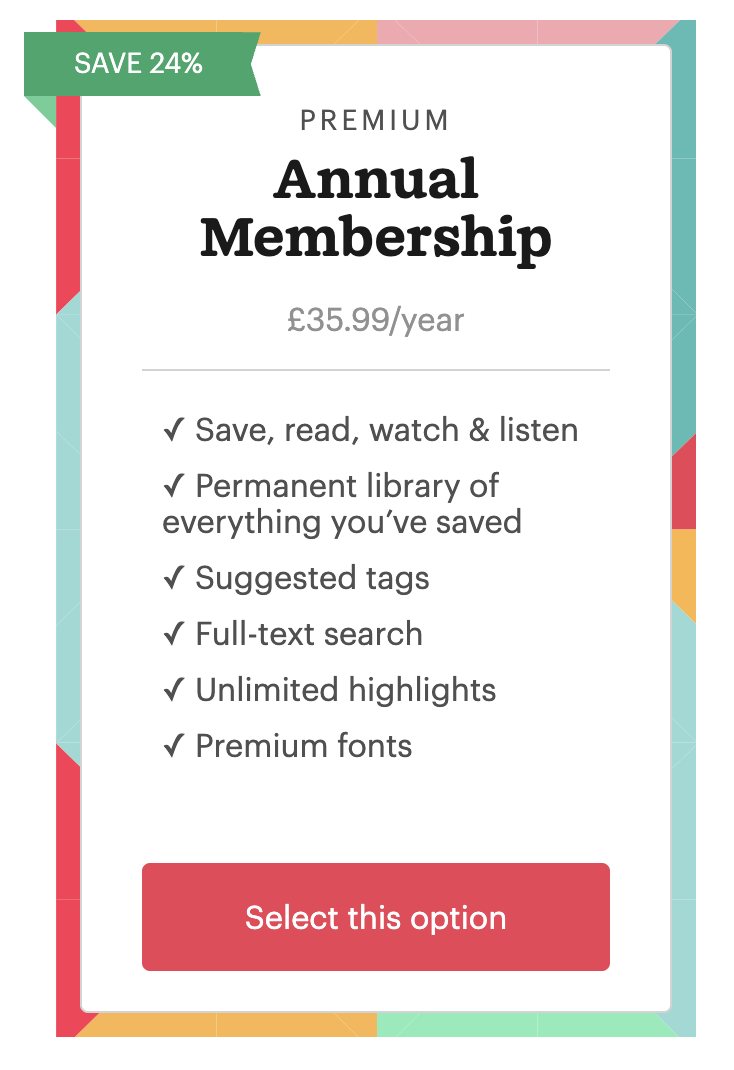
Below I list the five benefits users supposedly get for buying a subscription (USPs), and my arguments for why I think we could improve our sales pitch. (For more information, visit https://getpocket.com/premium)
(0) Save, read, watch & listen: This is the main use case of the app, and the subscription page admits I can already do these things as a non-subscribed user. Not a reason for buying, not even a USP.
(1) Permanent library of everything you’ve saved: Telling potential subscribers at the same time that (a) the library of non-subscribed users is non-permanent *gasp* without going into detail about when my items will start disappearing, and so not capitalizing on the instilled fear, and yet at the same time, (b), calling to mind that, historically, idealistic web utilities have folded, wiping all their user-generated content as they go (Google Reader, etc.). Yeah you’re right, conversion funnel: on the internet, no consumer service is permanent. So why pay for Pocket’s archive? It’s going to go away next month probably, anyway. Not a reason for buying.
(2) Suggested tags: For what exactly? I genuinely wonder who uses this. Instead of neatly stacking my articles into tag-based lists by hand, my articles get labeled but automatically? And probably with labels that almost but not quite match my own system? We will return to this idea of useless productivity when we explore how to improve the Reading experience. Not a reason for buying.
(3) Full-text search: So the Search functionality for non-subscribed users does not search through articles? That explains why it’s so poor at finding what I’m looking for. Providing a bad user experience upfront, however, does not fill consumers with confidence that things will be better on the other side of the paywall. Not a reason for buying.
(4) Unlimited highlights: There’s a limit to how much I can highlight? Somehow, the idea of charging for the digital equivalent of neon ink feels like excessive nickel-and-diming. Not a reason for buying.
(5) Premium fonts: The connection is never made explicit, but this benefit is supposed to speak to consumers who desperately – and understandably – want to improve the reading experience. Again, a bad consumer experience does not make a convincing argument for paying. But aside from that, the font is not the main problem with the reading experience, as we will see when we explore improvements. Not a reason for buying.
(6) What to pay for instead: If these USPs aren’t convincing, what will people pay for? Why are people currently paying for Pocket? I think that, in spite of the USPs mentioned above, people currently paying for Pocket do so because they want to feel like they contribute. They’re paying to keep a great part of the internet alive. And that’s great – except that if that’s our main reason for conversion, I’d expect it on the subscription page as a USP (The Guardian does this very effectively).
That’s why I think people currently subscribe. But let’s first look at what functionality Pocket actually provides and if we can find valuable features and improvements there.
Pocket’s jobs to be done, and further improvements
For Pocket users, the application has 4 general jobs to be done, that I list below in order of priority:
Saving
Reading
Sharing
Discovering
I will describe how Pocket has chosen to address those jobs (its feature set) in some detail and suggest improvements.
Saving
Pocket’s main job to be done is saving that interesting article for later consumption, because I can’t read it right now. Pocket handles that by providing save extensions and browser plugins on all platforms, coupled with a user account, and a landing page or app where logged-in users find all their saved articles.
The Saving experience works very reliably. Though on the web, for the stressy mindset that motivates users to click their browser extension, it is somewhat cluttered. I mean that I have no desire to organize my tags from a miniscule ‘save successful’ confirmation popup as I hurriedly move the cursor towards the ‘close tab’ button while my manager’s shadow slowly spreads itself across the surface of my standing desk. On mobile, the confirmation popup doesn’t dismiss itself automatically. Imagine you’re a squirrel, and you have a nut that sticks to your little claws when you want to store it away. How would you feel? Also, is that magpie following us? Also, there seems to be a persistent issue with opening iOS share sheets from in-app Safari webviews, but that’s not Pocket’s fault.
Saving needs to be reliable, fast, and hassle-free. Pocket is almost there, but not quite.
Reading
Saving is for many users as much aspirational as it is actually useful. Like squirrels scouring the forest to find nuts that they then methodically store and only sometimes consume, so too do Pocket users browse the web, conscientiously save articles, and then sometimes come to Pocket to read those articles. In short: it is my conjecture that people save more articles than they read.
However, I will also bet good money that most Pocket users want more time to read. If they could spend more time on Pocket and just read, like in the old days before the Internet mushed their brains, they would. It’s just that they feel drawn to their darn phones so much.
Let’s help the poor suckers! Let’s explain how they can wean themselves off the dopamine drip. Help them block time for reading in their calendar. Educate them on deleting apps, or setting up Focus Time, blocking access to sites, or putting away their phone. Hire someone to try out every digital detox method and write about it. Send digests and article lists on Saturday morning. Encourage printing articles for offline reading, or send out personalized printed feeds yourself. Sell our users Kobo ereaders!
Real reading is more than just reading more, though. Active reading requires highlighting and note-taking, and revisiting those notes, and being able to gather up those notes, and take them with us to our desk to use in our writing (see also: Sönke Ahrends, ‘How to Take Smart Notes’). Highlights and notes, at their best, are ready-to-go building blocks for writing new articles. But Pocket highlights in their current implementation are not easily translated into new writing, because they are not even stand-alone notes. Instead, on the web, the ‘Pocket highlights’ button brings you to a list of all articles that have highlights in them… In the meantime, fucking Readwise moves into the ‘saving web articles’ space, people! – The solution is obvious. Enable people to write about the articles they read on Pocket: first, present highlights as standalone input for the writing/thinking process. Then allow more complex note taking with a full-on focused writing environment, then integrate with Kobo’s highlights and notes feature for ebooks, collecting those inputs in Pocket for elaboration, then allow for ebook reading directly from Pocket, then randomly resurface noteless quotes to gobble up Readwise, then Goodreads, then buy Kobo (because “people who are really serious about software should make their own hardware”, to quote Alan Kay).
I haven’t even gotten to the core reading experience, which is… not good. It’s not good, partly because of reasons beyond our control (GDPR, paywalls), but also because of some poor but seemingly deliberate choices in fonts, for example.
By the way, have you considered creating RSS feeds out of those article listening experiences? So people can listen to their Pocket queue from their podcast app?
Sharing
People want to share the crazy stuff they read online. With friends, for a laugh, or in their semi-social bubble or in the company Slack, to impress. Sending a link is good enough between friends – but why not help out the ambitious reader a bit? Automatically send out an email digest of their favorite articles each week to their subscribers, complete with notes and commentary if they want. Maybe we even allow people to monetize their curation, as Ghost and Substack and now Twitter-owned Revue do.
Then, when people use Pocket to easily curate reading lists, and compose and share digests, are we truly laying the groundwork for Pocket to become a destination – which is where ML comes in.
Discovery
Squirrels don’t need more nuts. They know where to find fresh nuts. The trouble is in locating the nuts they buried last week. The same goes for our users: new content is not the issue. Current Pocket users already know what sources to check for articles. Improving the Discovery part of the app is not crucial for those core users.
The people that need help discovering new articles are those that currently get their content via Facebook, Twitter, Reddit. For them, Pocket can become a destination, a safe haven for normies realizing that they long for stress-free reading and thinking. However, the normies will come to Pocket and not see anything in their queue. That group of people, we can serve with machine learning, by surfacing new Pocket-made curated lists and think pieces, most saved and most shared articles, friends’ digests, etc.
Conclusion
I think I’ve shown convincingly that despite Pocket’s great brand and mission, its monetization strategy and functionality are deeply, deeply flawed. We’ve explored where and how to improve its feature set, and at the top you find my 12-month plan.
By implementing my 12-month plan, I’m confident we can take Pocket to new heights: it will help active readers to share their voice, it will finally get the success it deserves as a great consumer product, and it will inspire young entrepreneurs that love the open web to build great new tools. Pocket, basically a small, old, dearly beloved web utility, can be an ally in the fight against surveillance capitalism and the death of democracy, and in the process, it can become insanely profitable.
With a new year starting, I thought I’d write a short post to recap the year, and to reflect on Q4 and 2021 as a whole.
Main takeaways: keep setting goals – and reflect on your progress
My main takeaway is definitely that I should keep setting goals. Q3 was when I really started experimenting with setting goals extensively and consistently for the first time in my life (not even very consistently). As you can read below, I trained for and ran 10k in an hour, and studied for the PMI exam. And then I would post updates on my progress on this blog. That reflection also really helped me focus and feel motivated. (I wasn’t able to take the PMI exam when I planned to due to bad planning, but I’ve booked a slot in the next few weeks.)
Then, after I stopped setting goals and organizing my time to achieve them in Q4, I definitely noticed right away how much I missed it. How much setting goals had helped me, in more ways than one.
Living out your days
For one thing, having goals and keeping myself accountable for reaching them greatly improved my mood. Because I was constantly working towards something that gave my life, for lack for a better word, meaning.
It was a bit stressful at times, because I’d set too many goals and then had to disappoint myself sometimes, because I didn’t have enough time to properly work on all of them.
But setting goals in itself, balancing sport and health on the one hand and learning and mental exercise on the other, and then reflecting on them, was effective and made me experience my hours as contributing to something, instead of just ‘living out my days’. So it’s definitely something I want to keep doing in 2022 (reintroduce, actually). Especially with the pandemic, it’s important to keep learning, exercising, maintaining friendships, just experiencing new things in general.
A list of fun things worth celebrating
So in my list of things I want to remember about 2021, setting and working towards achieving goals is definitely the most important one, because it’s so fundamental.
But I have other highlights as well (inspired by Ernst-Jan Pfauth’s list (Dutch)). In no particular order:
Training for a 10k (cardio and strength) made me feel much healthier and fitter. Using your body every day gives you much more pleasant aches and pains in your body than the stings and sighs you experience when you don’t train. I’m going to train for it again this quarter, trying to improve my 59 minutes record – even though I hated actually running those 10 kilometers while I was doing it.
I did a leadership course in the second half of the year. The most important takeaway for me was understanding that relationships are actually more important than just about anything else you can do. If the relationship isn’t good – between parents, coworkers, friends – no framework or methodology will help you reach your goals. You need to work on the trust first. That might sound obvious to some, but for me it was a real eye-opener, and it has changed my perspective on work and personal life immensely.
I became a vegetarian early in the year, after reading Safran Foer’s ‘Eating Animals’. I really miss the taste of meat – but I’m happy I stopped because I no longer feel guilty for eating it. It had the convenient side-effect of improving my cooking a lot (after having invested in lots of new cookbooks and newsletter subscriptions). I’m much more creative now, because I’ve had to relearn how to construct a nutritious and tasty meal.
Chili flakes/sambal pepper: I never believed in it, thought chili powder could achieve the same for your meal. But chili flakes really add a lot of flavor to your food without over-spicing it too much. It’s my new favorite spice!
I bought a Nintendo Switch just before 2020/2021 New Year’s, just to have something to do during those bleak dark days in lockdown. I am very surprised at just how much fun we were able to get from it in a year. I’m using it every Sunday for a Fortnite game with some friends (see below). And my son and I play age-appropriate games every weekend. (My tip for the 5-year old in your household: Pikuniku.)
That weekly Fortnite game is something I look forward to every week. It’s the cap on a nice weekend, and a fun start of the week. Plus: I speak to my friends more often.
This year, a not insignificant number of people I know have benefited from mood-enhancing medication. I’m very grateful that it exists.
They made ‘Dune’ into a decent movie! The book was like a foundational text for me when I was a teenager, and I enjoyed Villeneuves visual spectacle (though I found the 2 lead actors boring and uninspired). Two other movies that I loved this year were Julie Ducournau’s Titane, about a disturbed and violent woman impregnated by a car, and Il Segno di Venere, whichI stumbled across on Netflix, an Italian comedy from 1955 that holds up surprisingly well, about a young woman trying to meet her future husband.
Had another really great intervision session. Intervision is a training technique where you and fellow trainees reflect on leadership, or whatever your training is about, in your day-to-day work, and how the course is changing your approach. The intervision sessions have been really good, because one of the participants has been really struggling with some stuff. That always makes for thought-provoking discussions! – Apart from that, finished the ‘Groeien in Leiderschap’ boek, and will soon start on ‘Socrates on Sneakers’.
PMI certification
I learned about Project Integration Management, the process of combining different parts of a project. That sounds vague, but is actually pretty straightforward work. For example, the new information about the costs for some part has to integrated with the budget limitations that were previously set. In all honesty, I’m a bit behind if I want to go up for certification before the end of Q3 D: . Will spend my time a bit better this sprint.
Running
Thursday: 6 km, 2/2/14/2/14/2
Sunday: 5km, 2/2/10/2/10/2
Wednesday: 7,8km, 2/2/13/2/13/2/13/2
Sunday: 5km, 2/2/10/2/10/2
So, the race I’m training for got cancelled, not entirely unexpectedly. I still want to do the 10km before the end of September. But my training is becoming to feel a bit useless: I could go out and run 10km tomorrow. I’d much rather do that and just be done with it.
‘Do you even enjoy running?’, somebody asked me the other day. Yes, I do. For the release I feel afterward. For the health and fitness benefits, obviously. But the running in itself? It feels like a chore, to be honest. I read articles about runners saying they like the pain, the exhaustion. I really don’t. So maybe after running that 10km, I stick to doing two 5km runs a week.
I suspect I would like rowing, though. Which is weird, because supposedly that’s even more brutal. But something about being on the water is really alluring to me, especially early mornings in winter. And it combines strength and cardio, which tickles the productivity guru in me.
Well, we’re going to find out, because I’ve joined a rowing club.
Books in progress
Margaret Atwood, The Handmaid’s Tale: The dystopian novel about the life of a woman in the Republic of Gilead, an extreme Christian-right America where women’s rights have been stripped away. Horror!
L. Frank Baum, The Marvelous Land of Oz: Another tale set in the world of Oz, that I read to fall asleep. Works like a charm!
This was a full-on vacation sprint, so I purposely put little thought and effort into my Leadership and PMI certification goals.
I did put a lot of thought into blogging, though. Especially the Recommended Reading posts I used to post here. I realized writing those little summaries that accompanied each link was time spent not writing actual blog posts. And I was always in a rush when I wrote them, so I ended up not being very happy with them. Half-assing what amounts to being a distraction is not how I want to spend my time. So I decided to stop posting them, in spite of the nice comments I got from some people (thanks for that!). Rest assured that writing actual blog posts will be one of my Q4 activities.
Running:
Thursday: 5km, 2/2/12/2/12
Sunday: 7.7km, 2/2/12/2/12/2/12
Tuesday: 5.5km, 2/2/12/2/14
Sunday: 6.7km, 2/2/10/2/10/2/10
Books in progress:
Laura Vanderkam, 168 hours: You Have More Time Than You Think: A week has 168 hours. Are you spending your hours the way you want to? Probably not. This book gives you some tips on how to live more intentionally. Which is supposed to make you happier. Thinking about writing a blog post about this, and the other book I’m reading next: Work Won’t Love You Back, which I suspect will be the antithese to 168 Hours.
(Finished) Frans Wilms, Groeien in Leiderschap: homework for the Leading Others course I’m participating in. I tend to be very task-oriented, and Wilms makes clear how to change that behavior, and why you should.
(Finished) L. Frank Baum, The Wonderful Wizard of Oz: Something to read before bed time. Fun to read the source material for so many movies and comics, and actually not half bad in its own right.
The Masochist’s Marathon – I probably will never run a marathon. I’m into walking a bit, but I’m no fanatic. I imagine that’s how marathon runners feel about ultrarunners, people who run multiple marathons on one day. Or worse, multiple marathons over multiple days. Darn fanatics. … And then there are people who run the Barkley Marathons.
I Didn’t Want To Deny My Husband His Marital Rights – ‘[Christie, an evangelical Christian, had] grown up believing if she was modest and remained a virgin until marriage and followed all the teachings she learned in youth group, then her marriage would be blessed. “I had to reconcile that expectation with reality,” Christy says.’
Suspendend Hell – Some days, I’d like to be good at Twitter, but then again: what would you be good at, really? Feeling anxious about the news and shouting at strangers. So for my health’s sake, I just read people’s reflections on how Twitter is destroying their life. I can’t recommend it enough.